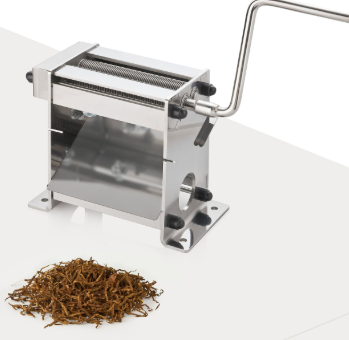
Selecting the right equipment is an important decision for businesses involved in shisha tobacco production. A Tobacco Cutting Machine can help manufacturers transform whole or partially processed tobacco leaves into consistent strips before the material moves into mixing and flavoring stages. The right machine can support production efficiency, cutting consistency, operator control, and integration with other processing equipment.
Understanding the Purpose of Tobacco Cutting Equipment
Tobacco cutting is an important preparation stage in shisha tobacco manufacturing. Before tobacco can be combined with ingredients such as molasses, glycerin, and flavoring, the leaves need to be prepared into a suitable form.
Manual cutting can be time-consuming and may produce variations in strip dimensions. Automated equipment provides a more controlled approach by feeding tobacco through a dedicated cutting mechanism and producing strips according to predefined settings.
The objective is not simply to cut tobacco quickly. A suitable machine should also provide consistent results and work reliably as part of the overall production process.
Production Capacity Should Match Your Needs
One of the first factors to consider when selecting cutting equipment is production capacity. Businesses should estimate how much tobacco they need to process per hour rather than choosing a machine based solely on its maximum advertised capacity.
A machine that is too small may become a production bottleneck, while unnecessarily large equipment may increase investment and operating requirements.
Shishapack offers different configurations for different production requirements. Its published categories include entry-level, mid-range, and high-performance machines, with listed capacities ranging from approximately 100–200 kg/hour to 350–500 kg/hour. The QYJ-200 model is listed with a capacity of 100–400 kg/hour.
Understanding the difference between machine categories and individual model specifications is therefore important when comparing options.
Consider the Required Cutting Size
Different shisha tobacco products may require different tobacco strip dimensions. For this reason, adjustable cutting settings can be an important feature.
Shishapack lists adjustable cutting widths for its tobacco cutting equipment. Category configurations are listed with cutting widths of approximately 1–20 mm, while the QYJ-200 specification gives a cutting length of 2–25 mm.
Manufacturers should determine their desired strip size before selecting a machine. It is also important to confirm the specific specifications of the model being considered rather than assuming that every configuration has identical settings.
Blade Quality and Durability
The cutting mechanism is one of the most important parts of the machine. Blades need to maintain their cutting performance during repeated industrial operation.
Shishapack states that its tobacco cutting machines can use hardened steel or tungsten-carbide blades. Optional titanium and ceramic coatings are also available.
Blade selection can affect durability, maintenance requirements, and cutting performance. Regular inspection is still necessary because even high-quality industrial blades can eventually become worn through continuous use.
Construction for Industrial Environments
Industrial equipment needs to withstand repeated operation while remaining practical to clean and maintain.
According to Shishapack, its tobacco cutting machines use food-grade stainless steel for the frame and body. Stainless steel offers corrosion resistance and is commonly valued in processing environments where cleanliness and durability are important.
The overall machine construction should be considered alongside factors such as access for cleaning, maintenance points, component quality, and the expected operating schedule.
Operator-Friendly Controls
Modern machinery should not only perform its primary function but also be straightforward for operators to control.
Shishapack’s tobacco cutting equipment uses a PLC touchscreen control system with multilingual interface options. This allows operators to manage machine functions through a centralized control panel.
A clear control system can help operators monitor the process and adjust settings according to production requirements. For facilities with multiple operators or international teams, multilingual controls can also make training and daily operation more convenient.
Safety Features Matter
Any machine containing moving blades requires appropriate safety measures. Protective guards, emergency stops, and monitoring systems can help reduce operational risks.
Shishapack describes safety features including protective guards, emergency-stop controls, and sensors designed to detect conditions such as jams or overloads. The company also states that its machines are designed and tested according to relevant EU safety requirements.
Businesses should always evaluate safety features alongside their own workplace procedures and applicable local regulations.
Integration With Other Processing Equipment
A cutting machine is usually only one part of a larger shisha tobacco production line. After cutting, tobacco may proceed to mixing, flavoring, dosing, and packaging.
Shishapack’s broader processing solutions are designed around these connected stages. Its tobacco cutting equipment can also be configured for integration with upstream and downstream machinery.
This type of integration can help businesses create a more organized production flow and reduce unnecessary manual handling between stages.
Customization for Different Operations
Every manufacturer has different production requirements. Tobacco type, capacity, desired cutting size, available factory space, and existing equipment can all influence the ideal machine configuration.
Shishapack offers customization based on factors such as tobacco characteristics, production capacity, cutting size, workflow, and additional functions. This can be particularly useful for manufacturers developing a new production line or upgrading an existing one.
See also: Time Attendance Systems in Dubai: What Businesses Need to Know in 2026
Conclusion
Choosing a tobacco cutting machine requires more than comparing price and production capacity. Manufacturers should consider cutting dimensions, blade technology, machine construction, controls, safety systems, maintenance, and compatibility with the rest of the production line.
A properly configured machine can provide consistent tobacco preparation while supporting a more efficient manufacturing workflow. By evaluating both current requirements and future production needs, businesses can select tobacco cutting equipment that fits their operation and provides a reliable foundation for subsequent shisha tobacco processing stages.